How to Prepare Your Home for a Hospital Bed: Room Setup Checklist
Get your home ready for a hospital bed delivery. This room setup checklist covers space, electrical access, flooring, and caregiver movement paths.
Sarah Nguyen
Patient Care Coordinator
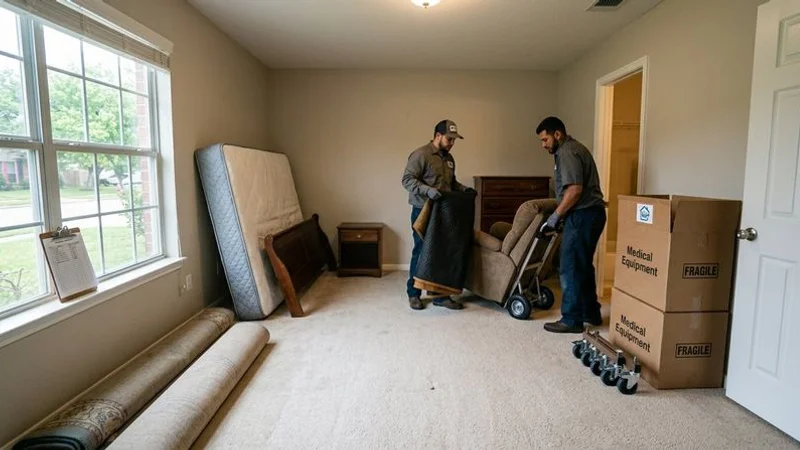
Bringing a hospital bed for home care into a living space changes the dynamic of the room.
We know this transition represents a shift from a standard bedroom to a care-focused environment.
This change is about more than just fitting a large piece of furniture through a doorway.
Our team sees this as a critical step in establishing a safe foundation for home recovery.
You might be surprised to learn that proper room setup often reduces the risk of caregiver injury by improving body mechanics during transfers.
We are going to walk you through the exact spatial, electrical, and safety requirements needed for a successful installation.
Choosing the Right Room
The first decision involves selecting the best location for the bed.
We find that most families instinctively choose the patient’s existing bedroom.
This choice offers familiarity and keeps personal items close at hand.
However, a different room often provides better safety or accessibility advantages.
Primary Location Options:
- The Ground-Floor Solution: Stair navigation presents a major fall risk for patients with limited mobility. A dining room or den on the first floor eliminates this hazard entirely.
- The Bathroom Proximity Rule: Statistics show that falls occur most frequently during transfers to the bathroom. Selecting a room adjacent to a bathroom significantly lowers this risk.
- The Existing Bedroom: This remains the best option if it is easily accessible or if the patient is bedbound.
Locations to Avoid:
- High-Traffic Zones: Kitchens or main hallways create noise levels that disrupt sleep cycles.
- Tight Quarters: Rooms smaller than 10x10 feet restrict the 360-degree access caregivers need.
- Thick Carpeted Areas: Plush carpeting creates resistance that makes locking mechanisms less effective.
Room Setup Checklist
Proper preparation prevents delays on delivery day.
We use this specific protocol to ensure every safety standard is met before the truck arrives.
Space Requirements
Medical equipment demands more square footage than standard furniture.
We recommend clearing a perimeter around the bed to accommodate medical accessories and emergency access.
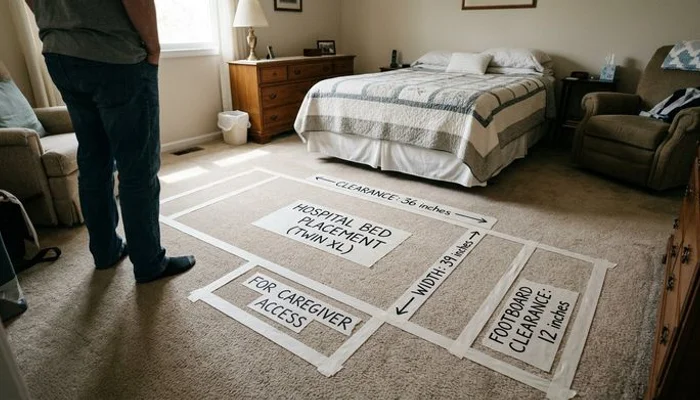
- Standard Bed Footprint: Clear a space of at least 4 feet by 8 feet for a standard medical bed.
- Bariatric Considerations: You must allow a footprint of 5 feet by 8 feet for bariatric beds.
- The “Golden Triangle” of Clearance:
- Transfer Side: Keep 36 to 48 inches clear on the patient’s exit side to accommodate a walker or wheelchair.
- Caregiver Side: Maintain 24 to 36 inches on the opposite side for sheet changes and wound care access.
- Footboard Zone: Leave 12 inches at the foot of the bed to prevent wall damage during tilt adjustments.
- Turning Radius: A wheelchair requires a 60-inch turning radius for safe maneuvering.
- Door Swing: Confirm the bedroom door can open fully without striking the bed frame.
Electrical Requirements
Hospital beds are powerful electrical appliances that require stable power sources.
We advise checking your home’s amperage capacity if you plan to use additional medical devices like oxygen concentrators.
- Grounded Outlets are Mandatory: The bed requires a standard three-prong grounded outlet (NEMA 5-15).
- Cord Length Limits: Most hospital bed power cords are 6 feet long. The head of the bed must be positioned within this distance of the outlet.
- Circuit Load Management:
Appliance Estimated Amperage Draw Standard Full-Electric Bed 2.5 - 4.0 Amps Low Air Loss Mattress 3.0 - 5.0 Amps Oxygen Concentrator 4.0 - 5.0 Amps Total Potential Load 9.5 - 14.0 Amps - Dedicated Circuits: A standard household circuit handles 15 or 20 amps. We suggest using a circuit not shared with space heaters or window AC units to prevent tripped breakers.
- The “No Extension Cord” Rule: Fire safety standards (NFPA) and manufacturers strictly prohibit extension cords for medical beds due to resistance buildup.
Flooring and Stability
The type of flooring impacts both the stability of the bed and the ease of moving it.
We frequently see issues with deep pile carpets causing caster drag.
- Optimal Surfaces: Hardwood, laminate, and commercial vinyl tile (VCT) offer the best surface for locking brakes.
- Carpet Considerations: Low-pile carpet is generally acceptable.
- Floor Protection: A hospital bed with a patient can weigh over 500 pounds. This weight focuses on four small points. We recommend using hard rubber caster cups to prevent indentations on soft wood floors.
- Rug Removal: Area rugs are the number one tripping hazard in home care settings. Secure them with industrial double-sided tape or remove them completely.
Furniture Rearrangement
The room must function as a care facility first and a bedroom second.
We encourage families to view the room layout through the lens of efficiency.
- Displace the Old Bed: A standard bed and a hospital bed rarely fit in the same room. Remove the existing bed to open up the floor plan.
- Strategic Nightstand Placement: Place a sturdy table on the patient’s dominant side.
- Obstacle Elimination: Remove ottomans, floor plants, and decorative baskets.
- Visitor Seating: Keep a firm, high-backed chair in the room. This provides a rest spot for visitors without cluttering the walking path.
Lighting and Visibility
Proper lighting reduces fall risks by up to 60% in elderly populations.
We suggest upgrading the room’s lighting to aid both the patient and the caregiver.
- Task Lighting: Caregivers need bright, cool-toned light (around 4000K) for administering medication or checking wounds.
- Motion Sensors: Install motion-activated lights along the path to the restroom.
- Touch Controls: Replace difficult twist-knobs with touch-sensitive lamps for patients with limited dexterity.
- Smart Plugs: Voice-activated lights allow a patient to illuminate the room without reaching for a switch.
For a deeper look at safety modifications, read our guide on fall prevention tips for elderly bedrooms.
Temperature and Air Quality
Patients in recovery often lose the ability to thermoregulate effectively.
We recommend establishing redundant climate control options.
- Individual Climate Control: Relying on a central thermostat is often insufficient. A portable heater or window AC unit gives the patient immediate control over their environment.
- Humidity Management: Respiratory patients benefit from humidity levels between 40% and 50%.
- Fan Direction: Ceiling fans should push air down (counterclockwise) in summer and pull cool air up (clockwise) in winter.
- Draft Avoidance: Position the head of the bed away from direct airflow vents to prevent drying out mucous membranes.
Delivery Path Preparation
The path from the front door to the bedroom is just as important as the room itself.
Our technicians need a clear, safe route to transport heavy bed components.
Preparation Steps:
- Measure the Pinch Points: Standard interior doors are 30 to 32 inches wide. If your door is narrower, we need to know beforehand to bring specialized tools.
- Clear the Hallway: Remove console tables, shoe racks, and wall art that protrudes into the hallway.
- Secure the Perimeter: Keep pets in a closed room or crate. Even friendly pets can be a tripping hazard when carrying 100-pound motor assemblies.
- Parking Access: Clear a space in the driveway or directly in front of the home. This reduces the distance our team must carry equipment.

Supplies to Have Ready
A hospital bed requires specific linens and accessories that standard beds do not.
We advise gathering these items a few days before delivery.
Essential Bedding:
- Twin XL Sheets: Most standard hospital beds require Twin XL (36” x 80”) sheets.
- Jersey Knit Material: This fabric stretches well and moves with the mattress as it articulates, unlike stiff cotton.
- Waterproof Protection: A high-quality mattress encasement protects the equipment from spills.
Comfort & Care Items:
- Hydration Station: A spill-proof tumbler with a long straw.
- Communication Device: A wireless doorbell or baby monitor is more effective than shouting for help.
- Power Strip (For Accessories Only): While the bed goes into the wall, a power strip on the nightstand is useful for charging phones and tablets.
- Entertainment: A tablet holder or TV remote within easy reach helps with boredom during recovery.
What You Do NOT Need to Prepare
There are several tasks you can cross off your list.
We handle the technical aspects of the installation entirely.
- Tool Kits: Our team arrives with all necessary wrenches and drills.
- Assembly Labor: This is a two-person job that we manage completely.
- Mattress Purchase: A therapeutic support surface is included with your order.
- Linen Application: We recommend leaving the bed unmade until we complete the safety demonstration.
Day-of Delivery Tips
Smooth deliveries happen when communication is clear.
We ask that a decision-maker be present to approve the final placement.
- Time Block: Allocate a 90-minute window. This covers assembly, safety checks, and the user tutorial.
- Patient Participation: If the patient is home, we can adjust the bed height and rail position to their specific body measurements immediately.
- Ask the Pros: Use this time to ask about emergency lowering functions.
You can learn more about the specific steps in our article on what to expect during hospital bed delivery.
We Handle the Hard Part
Preparation is the only task that falls on your shoulders.
We take care of the heavy lifting, the technical assembly, and the packaging disposal.
This level of care is standard with our white-glove service promise.
Contact us for a free quote or call (713) 555-0123 to schedule your delivery.
Need a Hospital Bed in Houston?
Get a free, no-obligation quote with transparent pricing and same-day delivery options.