Alternating Pressure Mattresses: How They Prevent Bedsores at Home
Learn how alternating pressure mattress systems work, who needs them, and how to choose the right one for home hospital bed care.
Sarah Nguyen
Patient Care Coordinator
Pressure injuries — commonly called bedsores or pressure ulcers — are one of the most serious complications for patients who spend extended time in bed. We know from experience that treating a single severe pressure ulcer can cost anywhere from $20,900 to over $151,700, according to AHRQ data.
Beyond the financial impact, these wounds cause immense suffering and can progress from mild redness to life-threatening infections in a matter of hours.
An alternating pressure mattress is one of the most effective tools for preventing and managing pressure injuries when using a hospital bed for home care. From what we have seen in the field, success comes down to choosing the right system and setting it up correctly.
Here is how they work and how to choose the right one.
How Pressure Injuries Develop
When a patient lies in the same position for too long, the weight of their body compresses the skin and underlying tissue against the mattress surface. This compression restricts blood flow to the compressed area.
The critical scientific threshold here is 32 mmHg. This is the average capillary closing pressure. If the pressure on the skin exceeds this number, the tiny blood vessels (capillaries) collapse.
The most vulnerable areas are where bone is close to the skin surface:
- Heels — the most common location
- Sacrum (tailbone) — especially in patients who lie on their back
- Shoulder blades — for patients on their back
- Hips — for patients who lie on their side
- Elbows and ankles — in thin patients
Without intervention, a pressure injury can develop in as few as 2-4 hours of unrelieved pressure. Once a wound forms, it can take weeks or months to heal.
How Alternating Pressure Mattresses Work
An alternating pressure mattress (APM) uses a system of air cells that inflate and deflate in a programmed cycle, typically every 5-10 minutes. Here is the basic process:
- The mattress is divided into rows of air cells running across its width
- Odd-numbered rows inflate while even-numbered rows deflate
- After a set interval, the pattern reverses — even rows inflate, odd rows deflate
- This continuous cycle means no single area of the body bears pressure for more than a few minutes
The result is that pressure is periodically removed, allowing blood to flow back into the tissues (a process called reperfusion). This mimics the effect of manual repositioning — which is the gold standard for pressure prevention — but it happens automatically, 24 hours a day.

Components of an APM System
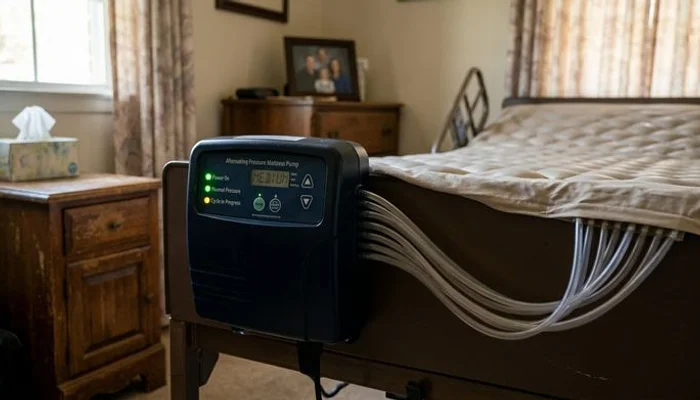
An alternating pressure mattress system consists of two parts:
The Mattress (or Overlay)
The air cell mattress sits on top of the hospital bed frame (replacement type) or on top of an existing mattress (overlay type). It contains rows of heavy-duty vinyl or nylon air cells connected by internal tubing.
The Pump
An electric pump sits at the foot of the bed and continuously operates to inflate and deflate the air cells. Modern pumps are designed to be quiet (most operate at 30-40 decibels — quieter than a refrigerator) and energy efficient.
The pump typically has:
- Pressure adjustment dial — to set firmness based on patient weight
- Cycle time selector — usually 5, 10, or 15 minutes
- Static mode — locks all cells inflated for transfers or procedures
- Low-pressure alarm — alerts if a cell fails to inflate properly
Pro Tip: Don’t ignore the air filter on the back of the pump. We find that a dirty filter is the #1 cause of pump failure. Check it monthly and rinse it with warm water if it looks dusty.
Who Needs an Alternating Pressure Mattress?
Determining need often involves the Braden Scale, a clinical tool used to score pressure ulcer risk from 6 to 23. A score of 12 or lower indicates high risk and usually necessitates an advanced support surface.
High priority (Medicare “Group 2” Criteria):
- Patients with multiple Stage II ulcers on the trunk or pelvis who have not improved after 30 days of standard care
- Patients with large Stage III or IV pressure injuries
- Patients who have had a recent skin flap or graft surgery (covered for 60 days)
- Patients scoring below 12 on the Braden Scale
Moderate priority (consider based on individual assessment):
- Patients who can reposition but do so infrequently
- Patients recovering from surgery with limited mobility
- Patients with incontinence (moisture increases skin vulnerability)
- Bariatric patients (higher body weight increases pressure on contact areas)
Low priority (standard mattress may suffice):
- Patients who are mobile and reposition frequently
- Short-term bed rest (less than 2 weeks)
- Patients with good nutrition and skin condition
Types of Alternating Pressure Systems
Alternating Pressure Overlay
Placed on top of an existing hospital bed mattress. The foam mattress provides the base support, and the overlay provides pressure redistribution.
| Feature | Details |
|---|---|
| Thickness | 3-5 inches |
| Installation | Placed on top of standard mattress |
| Weight capacity | Up to 300 lbs (varies) |
| Cost | $ (most affordable) |
| Best for | Prevention in lower-risk patients |
Alternating Pressure Replacement Mattress
Replaces the standard mattress entirely. Provides both support and pressure redistribution in one unit.
| Feature | Details |
|---|---|
| Thickness | 8-10 inches |
| Installation | Replaces existing mattress |
| Weight capacity | Up to 450 lbs (standard) / 800 lbs (bariatric) |
| Cost | $$$ (moderate-high) |
| Best for | Treatment and prevention in moderate-high risk patients |
Low-Air-Loss Mattress with Alternating Pressure
The most advanced system. Combines alternating pressure with low-air-loss technology — a gentle flow of air through tiny laser-cut holes in the mattress surface that keeps the skin cool and dry. This is critical for patients with excessive sweating or incontinence issues.
| Feature | Details |
|---|---|
| Thickness | 8-10 inches |
| Installation | Replaces existing mattress |
| Weight capacity | Up to 500 lbs (standard) / 1,000 lbs (bariatric) |
| Cost | $$$$ (highest) |
| Best for | Active wound treatment, high-risk patients |
Setting Up an APM at Home
Setting up an alternating pressure system properly is important for effectiveness and safety:
- Place the mattress correctly — air cells face up, head end at the head of the bed
- Connect the tubing — from mattress to pump (follow color-coded connectors)
- Position the pump — at the foot of the bed, off the floor, with adequate ventilation
- Set the pressure — adjust based on patient weight (higher weight = higher pressure)
- Set the cycle time — start with 10 minutes unless directed otherwise
- Test the system — watch for one complete cycle to verify all cells inflate properly
- Place a sheet over the mattress — use a fitted sheet that is not too tight (tight sheets restrict cell movement)
The “Hand Check” Safety Test
We always teach families this simple test to ensure the patient isn’t “bottoming out” (resting on the hard bed frame).
Slide your hand, palm up, under the air cells directly beneath the patient’s bottom (sacrum). You should feel at least 1 inch of air cushion between their body and the bed frame. If you can feel their bone resting on your hand, the pressure is too low.
Our delivery team handles all setup and demonstrates the pump controls during installation.
Common Questions
Is the pump noisy? Modern pumps are designed for home use and operate at 30-40 decibels — about the volume of a quiet library. Most patients and families adjust to the sound within a day.
Can the patient feel the cells moving? Most patients feel a gentle shifting sensation that many find soothing. It is subtle enough that most patients sleep through the cycles after the first night or two.
What happens during a power outage? Without power, the cells will gradually deflate. The patient should be repositioned manually if the power is out for more than 30 minutes. Consider a battery backup for patients at high risk.
Can the mattress be used with side rails? Yes. Alternating pressure mattresses work with all standard hospital bed side rails. The mattress should fit snugly within the bed frame without gaps.
How often do APMs need maintenance? Check weekly for proper cell inflation. Clean the mattress cover monthly using a 1:10 bleach solution or EPA-registered disinfectant wipes. Replace air cells if they develop slow leaks (we handle this for rental customers).
Adding an APM to Your Hospital Bed
If your loved one already has a hospital bed from us, adding an alternating pressure system is straightforward. We deliver the system, set it up on the existing bed, calibrate the pump, and train you on the controls.
If you are getting a new bed and mattress together, we will help you choose the right combination during your consultation. Visit our mattresses and accessories page for an overview of all available mattress types.
Contact us for a free quote or call (713) 555-0123 — we will help you determine if an alternating pressure system is right for your loved one’s needs.
Need a Hospital Bed in Houston?
Get a free, no-obligation quote with transparent pricing and same-day delivery options.